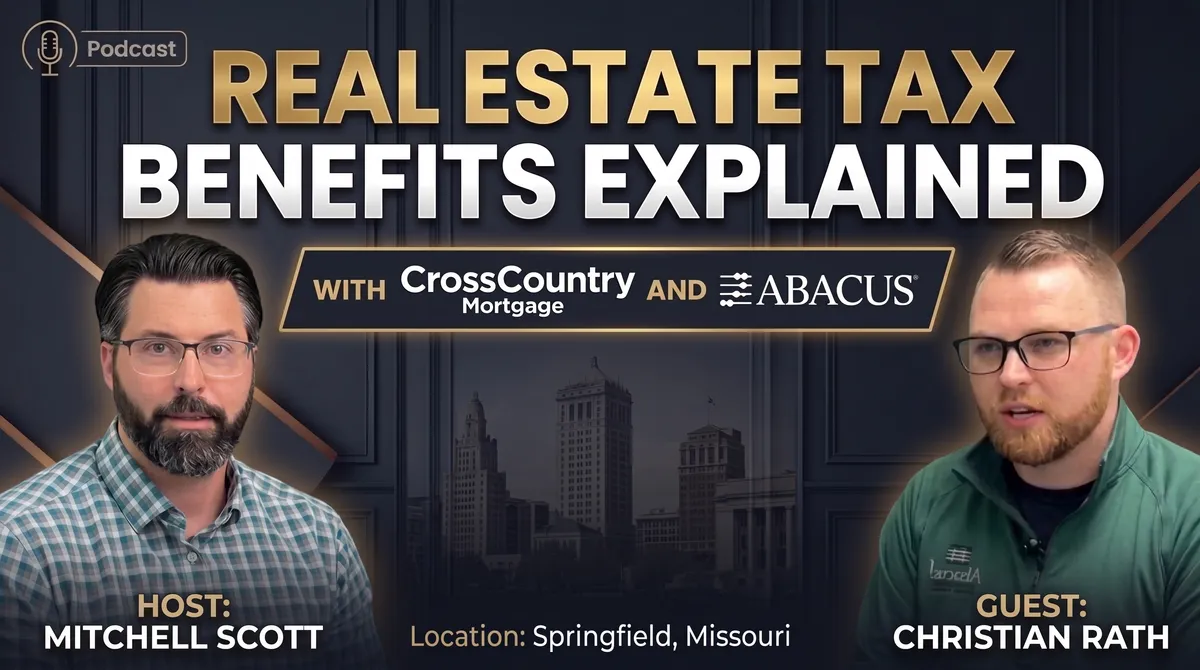
Real Estate Tax Strategies Explained: Mitchell Scott and CPA Cristian Rath Break Down What Investors Need to Know
The Conversation Most Real Estate Investors Never Have With Their Accountant
Mitchell Scott at CrossCountry Mortgage in Springfield, Missouri sat down with Cristian Rath, Director of Tax at Abacus, for a conversation that covers the territory most real estate investors wish someone had walked them through before they bought their first property. Not generic tax tips pulled from a social media reel but a genuine discussion about how tax law intersects with real estate investing and why every situation is different enough that the only way to know what applies to you is to have the specific conversation with a qualified professional.
Cristian has been with Abacus for nearly eleven years, starting as an intern and working his way to Director of Tax. Abacus is a full-service accounting firm with eight offices and approximately one hundred and fifty employees across the United States. It handles accounting, taxes, payroll, and audits while also offering what Cristian describes as back-office efficiency solutions through AI and process improvement. He focuses significantly on real estate clients and that expertise is the foundation of this entire conversation.
The disclaimer that runs through everything that follows is worth stating clearly at the start. Every tax situation is different. The strategies discussed here may or may not apply to your specific income level, employment structure, property type, or financial goals. This is a bird's eye view. Getting into the specifics requires a face-to-face conversation with qualified professionals who know your actual numbers.
Is Buying Real Estate a Good Tax Strategy?
Cristian's honest answer is that it depends. Real estate does carry significant tax benefits in many situations. But those benefits are not automatic, they are not universal, and they do not justify buying a bad property just to capture a deduction.
The framework he uses is simple. Do good business first. Find property that cash flows. Find property that fits your lifestyle and your capacity to manage it. Then use the tax benefits to accelerate what you are already building rather than treating the tax tail as the reason the dog is running.
With that foundation in place there are three major tax benefits that make real estate consistently attractive as an investment vehicle.
Benefit One: No Self-Employment Tax on Rental Income
Traditional W-2 employment income and self-employment income are both subject to FICA taxes that go beyond simple income tax. Long-term residential and commercial rental income in most structures does not carry that self-employment tax burden. For someone in a higher income bracket that difference is meaningful. The rental income gets taxed at ordinary income rates or capital gains rates depending on the situation but without the additional self-employment tax layer that applies to most other forms of active income.
Benefit Two: Cost Segregation and Accelerated Depreciation
This is where the numbers can get genuinely significant for the right investor in the right situation.
When you buy a commercial building you are typically required to depreciate the cost over thirty-nine years. That is a long time to wait for a deduction on something you just purchased. A cost segregation study involves an engineer evaluating the property and reclassifying portions of it from the standard thirty-nine year building category into shorter-lived property categories of five, seven, ten, and fifteen years.
Abacus partners with engineers on these studies and Cristian reports that on average they see twenty-five to thirty-five percent of a total purchase price reclassified into those shorter categories. With current bonus depreciation rules anything classified in the five, seven, ten, or fifteen year buckets can be depreciated in the first year. On a one million dollar property that could mean two hundred and fifty thousand dollars or more in deductions in year one.
For an investor in the top federal bracket at thirty-seven percent plus state taxes that can represent a forty percent or higher return on the tax savings alone. The cost segregation study itself has become significantly more affordable than it was ten to fifteen years ago and for qualifying investors in meaningful brackets the math often works clearly in favor of doing one.
The important caveat is that cost segregation is most effective as a long-term hold strategy. Cristian recommends planning to hold a property for five to seven years minimum before pursuing a cost seg because the benefit is time-value-of-money based. You are accelerating a deduction you would have received anyway. If you sell too soon you face depreciation recapture. The strategy is built for patient investors building wealth over time.
Benefit Three: Step-Up in Basis at Death
This is the one that most investors either do not know about or underestimate. When a real estate investor dies and passes a property to heirs the heirs receive what is called a step-up in basis. The basis of the property resets to its fair market value at the time of death rather than the original purchase price.
If a property was purchased for one hundred thousand dollars and is worth five hundred thousand dollars at the time of death the heirs can sell it for five hundred thousand and owe no income tax on that four hundred thousand dollar gain. The appreciation built over decades of ownership can transfer to the next generation without triggering the capital gains tax that would apply to a sale during the investor's lifetime.
For most taxpayers below certain estate value thresholds this benefit applies fully. It is one of the most powerful tools in generational wealth transfer and real estate is uniquely positioned to take advantage of it.
How to Hold the Property: LLC, Trust, and the Right Structure
Cristian is quick to note that entity structure questions involve both tax law and legal considerations and he defers to attorneys on the legal side while handling the tax implications.
What he sees most commonly and what most attorneys recommend is holding investment property in an LLC rather than personally. The LLC provides a layer of legal separation, allows the property to operate under a business name rather than a personal social security number, and creates the structure through which contractors get paid and tenants interact with the business rather than with the individual owner directly.
From a pure tax standpoint holding in an LLC versus personally does not always change the taxability dramatically. A single-member LLC typically flows through to a Schedule E on the personal return. A partnership with a spouse may require a separate partnership return depending on the state. S Corps and C Corps are structures Abacus generally does not recommend for real estate for technical reasons related to how gains, losses, and appreciation are treated.
Trusts come into the conversation most frequently around generational planning. When the goal is passing real estate to heirs efficiently and with appropriate protections trusts work alongside the LLC structure rather than replacing it. Mitchell described his own structure as using both, with the LLC owned by a trust, creating multiple layers of protection for the assets being built for his family. Cristian noted that the goal is never to make it so layered that it becomes complicated or that the owner loses access to the economic benefits. The structure should provide protection and flexibility simultaneously.
The Real Estate Professional Designation and Why It Matters
The real estate professional designation in tax law is one of the most misunderstood concepts Cristian encounters. It is not a license. It does not mean you are a real estate agent. It is a tax designation that requires specific hour thresholds and professional activity qualifications. Real estate agents, contractors who build properties, developers, and others whose primary professional activity relates to real estate can potentially qualify.
Why does it matter? Because investors who do not qualify as real estate professionals and whose combined household income exceeds one hundred and fifty thousand dollars lose the ability to use rental property losses to offset other income. Two of the three major benefits still apply. No self-employment tax on rental income still applies. The step-up in basis at death still applies. But the passive loss offset that makes cost segregation so powerful for high-income investors requires either the real estate professional designation or an alternative structure.
For high-income investors who cannot qualify as real estate professionals there is a path through short-term rentals structured as active businesses under Schedule C rather than passive rentals under Schedule E. This structure does subject the income to self-employment tax but it also unlocks the ability to use cost segregation losses to offset other income. Whether that trade-off makes sense requires running the actual numbers for the specific situation.
Cash Flow First: Why Tax Strategy Follows Business Quality
One of the most important themes in this entire conversation is the sequencing of decisions. Tax benefits are a reason to invest in real estate. They are not a sufficient reason on their own. Cristian is direct about having seen investors who got into properties because of the tax narrative and ended up with assets that were losing cash money with no clear path to profitability. The tax benefits did not materialize as expected because their specific situation did not qualify and the property was a cash drain rather than a cash producer.
The goal is to find property that cash flows, or at minimum breaks even with a credible thesis for near-term profitability, in a location and format that fits the investor's lifestyle and capacity. Then layer the tax strategy on top of a solid underlying investment to accelerate wealth building. Not the reverse.
For investors who cannot be hands-on with repairs and maintenance the numbers need to work with professional management costs included. For investors who can do significant work themselves the numbers get meaningfully better because labor cost is eliminated from the equation. Cristian noted that the ability to do property work yourself is genuinely one of the biggest financial advantages an individual investor can bring to real estate. Cash flow is king and anything that reduces costs improves cash flow.
What Happens When You Sell: Capital Gains and the 1031 Exchange
When an investor sells a held property the gain is typically taxed at capital gains rates rather than ordinary income rates. Long-term capital gains rates max out at twenty percent for most investors which is meaningfully below the thirty-seven percent top ordinary income bracket. That preferential treatment on appreciation is another component of why real estate compares favorably to other investment types for long-term holders.
Depreciation recapture does apply when a property is sold. The depreciation taken during the holding period gets recaptured at a different rate and Cristian recommends running the full picture before assuming a sale is the right move.
The 1031 exchange is the other major tool available at the point of sale. A 1031 exchange allows an investor to sell one property and roll the proceeds into another qualifying property without triggering capital gains tax on the gain from the sale. The investor has a defined window from the sale date to close on the replacement property and the rules around what qualifies are specific. But when executed correctly a 1031 exchange allows an investor to move nine hundred thousand dollars of appreciation from one property into the next without paying a dollar of tax on it. The wealth stays compounding rather than being partially liquidated for taxes.
Common Pitfalls Worth Knowing Before You Start
Cristian identified several patterns worth avoiding.
Assuming tax deductions apply to your situation without having the conversation with a professional is the most common and most costly. The TikTok reel that says real estate is an automatic tax deduction does not know your income, your employment structure, your hours, or your property type.
Assuming real estate always appreciates and always makes money is a related mistake. Real estate is a genuine investment with genuine risk. Market conditions change. Tenants create challenges. Unexpected costs arrive. Having adequate reserves and buying property that cash flows provides meaningful protection against these risks but does not eliminate them entirely.
Flipping is a completely separate world from the buy and hold strategies described here. A flip is treated as inventory from a tax standpoint, not as a capital asset. Almost none of the strategies in this conversation apply to flips. Understanding which mode you are operating in before making decisions about tax strategy is foundational.
Getting multiple bids on every major project is practical advice that Cristian offered from personal experience. He saved three thousand dollars on an HVAC replacement by contacting five additional contractors after the first quote felt off. The best contractor for the job is not always the first one who shows up and getting multiple perspectives often reveals options that a single bidder would not have proposed.
The Broader Picture
Real estate is one of the most commonly held assets among high-net-worth individuals in the United States for reasons that go beyond tax advantages alone. The ability to see, touch, and influence a tangible asset provides a sense of control that stock market investing does not. The tax code is written in ways that consistently reward long-term real estate ownership. And the combination of rental income, appreciation, and tax efficiency creates a compounding effect that builds wealth over decades for investors who approach it with patience and proper guidance.
Mitchell Scott works with investors in Southwest Missouri and the surrounding region to structure financing that makes real estate acquisition possible even for newer business owners and self-employed borrowers who may not yet have the two-to-three-year history traditional banks require. Cristian Rath and the team at Abacus provide the tax guidance that ensures the investment is structured to capture every available benefit.
Reach out to Mitchell Scott at CrossCountry Mortgage in Springfield with questions about financing your next investment property. Connect with Abacus to discuss the tax strategy that fits your specific situation.
Sources
IRS.gov
ConsumerFinancialProtectionBureau.gov
Investopedia.com
BiggerPockets.com
NationalAssociationofTaxProfessionals.org
